Showing posts with label Design. Show all posts

Tuesday, October 26, 2010

Retro Obsession: DMC DeLorean


"We will do anything to keep this company alive."
-John DeLorean


It's inevitable I guess. 25 years gone and we're celebrating a movie that exploded the membrane of American pop culture. Back to the Future was certainly not the first motion picture to drive automotive sales, nor will it be the last, but what is notable is how much acclaim the DMC DeLorean has received despite the epic career flameout that befell its namesake.

This is a beloved piece of machinery. The stainless steel and winged throttle rocket became a cultural icon even before the movie hit Betamax.

Flux capacitor, nose candy, and Huey Lewis aside.

(Pictured below is Pontiac's former golden-boy John DeLorean in marketing stills for the DMC-12. His master stroke at Pontiac was the legendary GTO.)


"After giving Pontiac its new style, DeLorean gradually transformed himself from a button-down conformist to a vain, middle-aged clotheshorse. He lost 60 lbs., began lifting weights and started draping his 6-ft. 4-in. frame in brightly colored shirts, turtlenecks and nipped-at-the-waist suits. He got a facelift (for a while he denied it) and affected longish hair, which he dyed black. He divorced his wife of 15 years, Elizabeth...He dated starlets, and, by now, every move had flair." Via.


"Detroit did not approve of DeLorean's lifestyle, so in 1973 he "fired GM" and set off on his own. The DeLorean myth grew. He was a maverick, a risk taker, and he had bold dreams...but what he really wanted to do was start his own car company and break the hold that Ford, Chrysler and GM had on the American auto industry. The sporty DMC-12, he thought, would do the trick. The sleek stainless-steel sports car with the distinctive gull-wing doors boasted a 130hp Renault engine and could go from zero to 60mph in eight seconds." Via.


"DeLorean needed $175 million to finance his dream. Over one hundred investors, including Johnny Carson and Sammy Davis, Jr., put over $12 million into a partnership for research and development while the British government produced $156 million in grants and loans in return for DeLorean locating the DMC factory in Northern Ireland. DeLorean risked relatively little of his own money -- $700,000 is the best estimate -- but he seemed to have made his dream come true. The Auto Prince lived like royalty in a $7.2 million, 20-room Fifth Avenue duplex, a $3.5 million estate in New Jersey and a $4 million California ranch. He made sure DMC's $25,000-a-month New York offices were located in a skyscraper that towered as high as the nearby GM building. He paid himself nearly half a million dollars a year and his estimated value in 1982 was $28 million. John Z. DeLorean was a real American success story, the poor boy who made good. Or so it appeared." Via.

"Unfortunately, the DMC-12 racked up mediocre sales figures. Entering the market in 1981, it faced stiff competition from Datsun, Mazda and Porsche sports cars. At $26,000, it cost $8,000 more than the Chevrolet Corvette. And of course a recession during 1981-82 didn't help, either. DeLorean expected to sell 12,000 cars a year; in the first six months only 3,000 DMC-12s were purchased. (A pair of 24-karat solid gold cars bearing $85,000 price tags were made for an American Express Christmas catalog; one resides in a glass showcase in the lobby of a Snyder, Texas bank and the other is in a Reno,Nevada car museum.) By February 1982 the DMC factory was in receivership, and in October of that year the British government ordered it shut down. DeLorean needed $17 million in a hurry to save his business. In desperation he entered into a drug-smuggling scheme, and in so doing walked right into a FBI sting operation designed to nab a smuggler named William Hetrick." Via.


"Hetrick was suspected of flying cocaine in from Colombia and moving it through the offices of a company called Morgan Aviation at Mojave Airport, ninety miles out of Los Angeles. He was looking for a bank that would launder his ill-gotten gains. The FBI confidential informant hooked Hetrick up with one agent posing as a bank officer and another who posed as a drug distributor. DeLorean then approached the CI, and was filmed and recorded at meetings in Washington D.C.'s L'Enfant Plaza Hotel as well as L.A.'s Bel Air Sands and the Sheraton Plaza. Hetrick was arrested after exchanging the cocaine for money; DeLorean was was taken into custody the following day when he flew into L.A. from New York. Ironically, he just missed a call from a banker who wanted to offer a legitimate $200 million loan that would have saved DMC, which shut its doors for good owing creditors $180 million. DeLorean's dream had turned to dust -- and left a lot of investors burned." Via.


"Interviewed by Rolling Stone's Aaron Latham in 1983, DeLorean claimed that he was trying to get a loan using stock in a shell company as collateral, and that he tried to back out of the deal after discovering that drugs were involved. At that point, according to DeLorean, the lives of his kids were threatened. Furthermore, the money paid for the drugs brought in by Hetrick was provided by the government. DeLorean suggested that the government was out to destroy him because the Big Three automakers wanted to see his enterprise fail; at other times he surmised that either the British government or the Irish Republican Army had set him up." Via.


"In 1984, DeLorean was acquitted of all charges after a federal judge ruled that the FBI operation had been a clear case of entrapment. He became a born-again Christian and wrote his autobiography. But in April, 1985 Christina divorced him, and that September a federal grand jury indicted him for income tax evasion and mail and wire fraud on evidence that he had bilked DMC investors, siphoning the funds into his private bank account. Though never convicted, DeLorean was ordered to reimburse creditors to the tune of $9 million. In 1995 a jury ordered him to pay the law firm of Morganroth and Morganroth $10.3 million in unpaid legal fees. In 1998 a New York jury ruled that DeLorean's accounting firm owed DMC investors $46 million, plus $65 million in interest." Via.


"It is believed that a total of 8,563 DMC-12s were built. Approximately 6,000 of them still exist today." Via.


Specs for the DMC-12:

Exterior: made of brushed stainless steel intended to be rust-free for 20 years. The undercarriage is glass-reinforced plastic. The vehicle sported counter-balanced gull wing doors.

Interior: leather/vinyl seats and dash, electric windows and mirrors, a 4-speaker stereo system, locking storage compartment behind driver's seat.

Engine: a rear-mounted, light alloy V6, 2.85 liter, single overhead cam, with maximum torque of 208Nm at 2,750 rpm, and a compression ratio of 8:8:1. The DMC-12 was produced from 1981 to 1983.


A stunningly rare marketing film for sales employees - Part 1:


Part 2:


DMC John DeLorean Documentary:

Friday, October 1, 2010

Hand-Crafted Since 1889


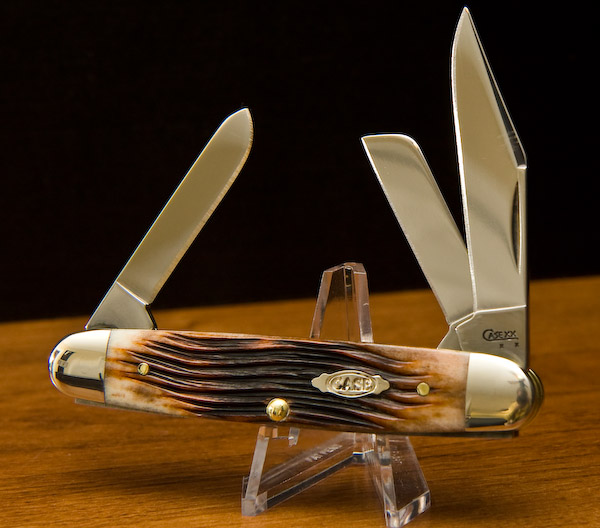
A couple of readers of this silly website have asked me about the knife I've used in previous posts. I have a veritable drawer full of old pocket-knives leftover from the days when I used to tool around the wilderness *gasp* for fun; from Swiss Army to Buck.

I don't get out camping as much as I used to (ok fine - at least 10 years), but I still make a point to walk through the camp supply section whenever in sporting goods stores. Even if you're not an outdoorsy person you can always use a good knife.

This particular one is a Case. Don't quote me on this, but I believe it is the Stockman. Currently a subsidiary of the Zippo Manufacturing Company, the Case brand has been around for well over 100 years. Now that's quality bub.

Tuesday, September 14, 2010

A Well-Suited Man...

Edward C. Gauvreau surveying 40 calling cards from businessmen in one day. April 1948, Washington, DC. Francis Miller. LIFE Magazine.


I started employment on a new job last week that carries with it a snazzy position title, and today I had to oversee the final edits to the business card.

Allow me to restate that salient point: MY BUSINESS CARD. A prospect thrilling enough all by itself, if it weren't for the fact that I was unemployed for a year and a half. Yeah, ouch. But, I began to think about the underlying meaning of this little 3 X 2 piece of weighted paper. Definitely one of the oft overlooked tools of the modern day business trade.

My new position will take me, literally, across the globe. With a firm handshake and a slight flip of the wrist my contact info will be distributed to the world.

I was curious about the history of business cards and fished around on the web to find suitable info. I found this:

In European Society:

...with the rise of the middle class during the Industrial Revolution and an overall lessening of social formality, a class of private entrepreneurs emerged in both Europe and the United States that had a constant need to exchange contact information...these were handed out widely at presentations and exhibitions but were looked upon with disdain by members of the upper class.

In the United States:

In the United States, however, business card use became widespread in the 1890s (the so-called age of the Captains of Industry or "robber barons") and the cards achieved their current level of ubiquity by the early 20th century.

Modern Business Card Etiquette and Format:

...Cards should not be carried loose but in appropriate card cases and should be maintained in pristine condition. The general rule of thumb is that the card should be presented in the condition in which the owner himself would appear for a high level business meeting -- immaculate and behaving according to the manners of the host nation.


That last bit is important. I am now on the search for a slick new card carrying case. Preferably something with vintage appeal. A well-suited man always needs...

Original Design © Copyright Cosmic Firefly. Via Etsy.

Original Design © Copyright Cosmic Firefly.

A bit too intricate for my purpose. But, you get the point. Via.

Not suitable for ALL businesses, but a conversation starter for sure. Via.

Sunday, September 12, 2010

Deus Bali

With a passion for surf, motorcycles, and life, the guys over at Deus Bali are the real deal.

SoBe

The Clevelander

The Ocean Five

The Avalon

Buick 1

Buick 2

The 11th Street Diner

Metropole - The Jersey Shore Season 2 Cast House

Wednesday, August 25, 2010

Automobiles d'Art Deco


"Life imitates art far more than art imitates life."
-Oscar Wilde


If you are a lover of classic automobiles and you find yourself in Oxnard, California it would be worth a visit to the new Mullin Automotive Museum.

According to the museum website:

The French Curves Collection exemplifies the zenith of the French automobile. The collection includes some of the most beautifully styled and amazingly engineered French-built cars covering several decades: Bugattis, Delages, Delahayes, Hispano Suizas, Talbot-Lagos and Voisins.

Many notable cars in this collection have won prestigious awards at concours d'elegance throughout the world. In addition, a number of the race cars have been past winners of historic races, such as the Grand Prix de Pau and Le Mans.


Gorgeous.

Photo credit to eXtravaganzi.


Saturday, July 24, 2010

The 'Mad Men' Look Contest: Final Results


Remember the Mad Men Look Contest that I entered?

*Spoiler alert* I lost.

I knew once that the heavy hitters started rolling in that I didn't have a shot in hell. There's no way that I can possibly compete with houses designed in the mid-century by award winning architects. Nope. Ain't happening folks. But I was contacted once by a Post employee so at least I felt like I was still in the running.

Just check out the winners already.

Monday, July 5, 2010

The 'Mad Men' Look Contest: The Washington Post


Mad Men season 4 begins at the end of the month and I'm pretty damn excited about this. It's far and away the best show on television. Shame on you and get with the program if you're not already a fan. Feelin' guilty yet?

Anyway, I was equally excited when I came across this recent article in the Washington Post:


Details about The Post's Mad Men Look contest
Saturday, June 26, 2010

Knotty pine. Wallpaper. Formica. Venetian blinds. Those lamps! They help form the distinctive look of homes portrayed on AMC's "Mad Men" television series, set in the 1960s.

As the series's new season draws near, we're looking for the Washington area home that most captures that look and feel. We invite you to pull back your pinch-pleat draperies and show off your home's late '50s-to-mid-'60s vibe.

Enter The Washington Post's Mad Men Look contest by submitting a photo of your place, whether it's a house, condo, apartment or even a single room. Entry deadline is midnight July 11. Entries must be for residences in the District, Maryland or Northern Virginia.

Entries must be of your own residence, whether owned or rented. Finalists must be available for photographs and an interview between July 14 and 18.

Finalists will be judged by a panel of Post editors and designers, along with Daniel Donnelly, owner of Daniel Donnelly Modern Design Studio in Alexandria.

Photographs of the winning entry will appear online and in The Post's Real Estate section July 24, the day before "Mad Men's" fourth season premieres.


I read this and thought, "why the hell not?" Sure I live in a small brick condo building built in the early 1980s, but have long been a fan of post-war modernism and mid-century modern style. Over the years I have cultivated furniture and various other odds-and-ends to match my particular tastes. I have an artistic eye and am pretty adept at scouting out oddball pieces from places such as thrift stores, flea markets, Ikea, Craigslist, eBay, etc.

I never win contests, other than a beauty pageant in Texas when I was 5 (true story), but I kind of really want to win this one. The contest is ramping up and the competition is fierce. Call me a Mad Man.

Click here to view all of the photos: http://washingtonpost.com/madmenlook.


Thursday, May 13, 2010

Modernism Alive and Well in NOVA


Modernism is an absolute passion of mine, but having lived in the Northern Virginia/DC Metro Area most of my adult life I have grown accustomed to the stodgy conservative architecture encompassing the region.

That is why I was stoked to stumble across an article in the Spring 2010 issue of Modernism magazine about the Hollin Hills neighborhood.

Situated a couple miles north of Frank Lloyd Wright's Pope-Leighey House, this 450 home development is anything but bland.

According to the article:

Hollin Hills got its start in the late 1940s when Robert Davenport, who had previously developed an experimental neighborhood in the same area, called Tauxemont, with colleagues from the Department of Agriculture, teamed up with Charles Goodman, one of the few modernist architects practicing in the Washington area. In Tauxemont, Davenport had drawn on his agricultural and New Deal background to build simple rectangular houses made of low-cost materials purchased in bulk and arranged to reflect the topography of the site. After acquiring a tract just north of Tauxemont that most developers thought unbuildable because it was so hilly, Davenport engaged Goodman as the architect. In Davenport, Goodman found a like-minded partner willing to build modern houses instead of the ubiquitous colonials then being constructed by the thousands across northern Virginia. The challenges of the site led Davenport and Goodman to bring modernist landscape architects into the mix. Their collaborative efforts to design, develop and market a subdivision based exclusively on modernist principles was unprecedented in the United States. The quality of their product garnered immediate attention; indeed, Hollin Hills won its first of many design awards in 1951, barely two years after the first homes were completed.

I took a short drive over to the neighborhood this afternoon and was instantly blown away by the modernist sophistication and level of care that has gone into these homes. Many of them were listed for sale, but I'm not sayin' which ones. Apparently I missed the spring homes tour by just two weeks, and instead had to settle for the stalkerish photos below. I hope to visit again soon in a more "official" capacity.


Large floor-to-ceiling windows, some in the form of doors, were standard on all Hollin Hills houses, enabling indoor/outdoor living and making the interiors of the modest houses appear larger. The interiors were so bright that many residents painted their walls dark colors. © Robert C. Lautman, Collection of the National Building Museum